
Compare Wilson County Property Value Types
One parcel in Wilson County can support several defensible numbers. Know which custodian produced a figure and what it represents before relying on it.
| Value | What It Is | Where |
|---|---|---|
| Appraised or market value | County estimate of fair market value as of the valuation date | Appraiser |
| Assessed value | Appraised value multiplied by the Kansas class rate | Appraiser and tax record |
| Agricultural use value | Productivity and income based value for agricultural land | Appraiser |
| Sale evidence | Transfer amount considered with comparable sales | Recorded deed and Appraiser |
A recorded sale informs valuation but never sets it alone. The Appraiser verifies each transaction and weighs comparable sales into the annual estimate.
Calculate Wilson County Residential Assessed Value
Residential real property in Kansas is assessed at 11.5 percent of appraised value. The state example turns $100,000 of appraised value into $11,500 of assessed value, which is why the assessed figure sits far below the appraised one. Mill levies then act on that assessed amount to produce the tax. The property tax guide covers bills and appeals.
Distinguish Wilson County Property Classes
Agricultural land is assessed at 30 percent of use value, yet the homesite on that land is market-valued separately at the residential rate. Commercial and industrial real property, along with agricultural improvements, use a 25 percent rate.
| Class | Basis | Rate |
|---|---|---|
| Residential | Appraised value | 11.5% |
| Agricultural land | Use value | 30% |
| Commercial / industrial | Appraised value | 25% |
| Vacant / not-for-profit | Applicable value | 12% |
Utilities are assessed at 33 percent, while other urban or rural property uses 30 percent.
Locate a Wilson County Assessed Value
Begin with the Treasurer search to resolve the address, CAMA, or tax ID. Then compare the parcel through the Appraiser public portal. Field labels there vary, so read the live ones.
- Resolve the parcel by address and save the CAMA.
- Read the value label, property class, and valuation year.
- Apply the correct class rate to the proper value basis.
- Compare recorded sale evidence without treating one sale as conclusive.
- Assessed value
- The class-adjusted amount used before levies.
- Market / appraised value
- The Appraiser's full-value estimate.
- Assessment ratio
- The constitutional class percentage.
Date a Wilson County Property Value
The Appraiser values real property annually as of January 1. Physical inspection and remeasurement occur at least once every six years, while permits and property changes help maintain the inventory.
A deed, notice, and portal update may carry different dates. Save the value year with each figure. A split, combination, or new plotting may create a new parcel ID.
Read Wilson County's Appraisal Guidance
The manifest captures the official Wilson County Appraiser FAQ behind the county's valuation explanations.
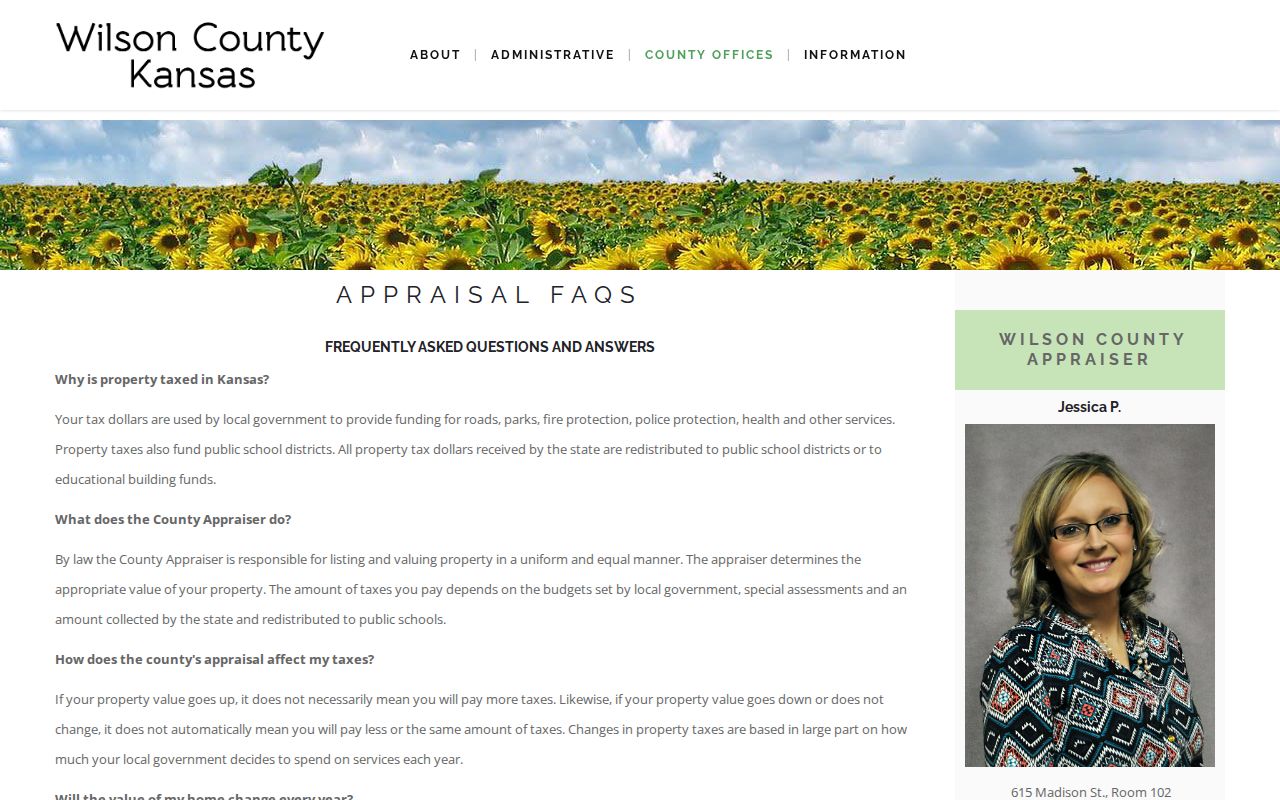
County guidance ties appraised value, assessed value, class rates, notices, and the annual process together. It never converts the public number into a sale appraisal.
Use Wilson County's 2026 Market Study Carefully
The county-linked 2026 market publication covers the 2025-to-2026 cycle. Its summary reported broad residential changes around 2 to 9 percent, many center values around 3 to 7 percent, stable vacant land due to limited data, and mixed commercial results. Those are wide signals rather than a result for any single parcel. Check the PDF header and read the property's own notice before applying the trend.
Build a Wilson County Property Value Workpaper
A solid workpaper records the parcel's CAMA, legal description, property class, and valuation date. It also lists appraised value, assessed value, and the source of any sale evidence. Show the arithmetic rather than copying a bare number with no label. For residential real property, multiplying appraised value by 11.5 percent should explain the assessed figure, subject to the live record and its classification. Keep agricultural land and its residence separate, because their value bases and rates differ. Mark any parcel split, combination, improvement, or permit that could shift the comparison. A good workpaper also saves the portal access date. It keeps county value distinct from an independent appraisal or an asking price.
Ask the Right Wilson County Value Office
The Appraiser's office sits at 615 Madison Street, Room 102 in Fredonia. That office owns parcel valuation and inventory questions. The Treasurer manages the tax account and payment status. The County Clerk certifies final mill levies after agency budgets and hearings. The Register of Deeds holds recorded transfer instruments. That division matters when numbers disagree. Ask the Appraiser what a value label and class mean. Ask the Register of Deeds for the relevant instrument. Ask the Treasurer or Clerk about tax context. Under KORA, describe the existing record by CAMA, year, and document type. Never ask one office to certify another office's number.
Audit a Wilson County Property Value Comparison
Verify that every figure belongs to the same parcel, class, and valuation year before drawing any conclusion. Recheck the CAMA segments and legal description if the address returned more than one result. Confirm whether agricultural land, a residence, and improvements were treated separately. Mark a sale as transfer evidence, not as a replacement for the annual valuation method. The portal and notice may differ. If so, preserve both dates and ask the Appraiser which roll is current. This final review keeps a correct calculation from attaching to the wrong tract. It also shows whether a difference comes from timing, classification, or each value's distinct purpose.
Compare Wilson County Sale Evidence With Value
The Register of Deeds preserves instrument and consideration evidence for Wilson County deed records. Financing, condition, and market context all matter. Each can push sale evidence away from annual value. Match the deed's legal description to the parcel before trusting it. A similarly addressed or partial-lot transfer is not the same property without that check. Note: One verified sale is evidence, not a complete market analysis.
Know What Wilson County Assessed Value Cannot Prove
An assessed value proves none of the following: a sale price, building condition, legal boundary, or title. It is one part of the Kansas tax framework. A private appraisal serves a different assignment and a different date.
Value versus price. Wilson County assessed value is for taxation and is not what the property will necessarily sell for. It is not a private appraisal.
When a public record is absent, use the county KORA page and identify the parcel and year.