
Wilson County Tax Record Fields
Start with the Wilson County tax search. The form accepts parcel type, year ranges, owner or taxpayer names, addresses, subdivisions, rural tracts, and payment-status filters. Read each figure beside its year, because appraised value, assessed value, and the final tax answer three different questions.
| Field | What It Shows | Where |
|---|---|---|
| Appraised value | County estimate of market value at the valuation date | Appraiser |
| Assessed value | Appraised value multiplied by the class rate | Appraiser |
| Taxing unit and levy | Jurisdiction and certified mills used in the bill | County Clerk |
| Tax bill and status | Year, amount, current or delinquent state | Treasurer |
| Owner / taxpayer | The selected name role tied to the account | Tax search |
The Appraiser revalues real property every year. It also inspects or remeasures each parcel at least once every six years. Levies and taxing-unit budgets shape the final bill too, so a change in the tax does not by itself prove a change in market value.
Wilson Values Use January First
Wilson County values use January first. The Appraiser estimates market value as of that date. A special class may follow another rule. That office also writes the property description. It assigns the permanent parcel ID. It does not set the final tax. The Clerk certifies mill levies once taxing agencies adopt budgets. The Treasurer handles statements and payment.
Kansas separates three figures. Appraised value is the market estimate. Assessed value is the appraised figure times the constitutional class rate. The bill applies levies to that assessed number. A deed's sale consideration is evidence the Appraiser may study. A single sale is never the annual appraisal.
Wilson Assessment Class Rates
Class rates drive the math. A Kansas Department of Revenue example applies an 11.5 percent class rate to residential real property. Agricultural land gets 30 percent of use value. Commercial and industrial real property sits at 25 percent. Vacant lots sit at 12 percent, public utilities at 33 percent, and other urban or rural property at 30 percent.
Agricultural land is valued under productivity and income rules rather than ordinary home-sale comparisons. Its residence is market-valued separately at the residential rate. Confirm the class shown for the parcel before comparing two Wilson County property tax records.
- Appraised value
- The county's estimate of market value.
- Assessed value
- The class-rate share used in tax calculations.
- Mill levy
- A tax rate applied to assessed value.
- Tax lien
- A statutory claim tied to unpaid tax.
Wilson Tax Search Filters
The county form takes a Starting Tax Year and an Ending Tax Year. Checkboxes flag properties with current taxes and statements with taxes due, whether current or delinquent. Name Match Type offers Current Owner, Taxpayer, or Both. Address fields cover number, name, direction, and ZIP.
Other paths exist. The eight-part CAMA, tax ID, subdivision, block, lot, section, township, range, lease name, and Quick Ref all narrow a query. Choose Real Estate for a land parcel. The official tax-search help page advises narrowing any slow or broad search.
Note: The current-owner and taxpayer choices can return different names, so never treat one label as a silent substitute for the other.
Look Up Wilson County Tax
Begin with a known address. CAMA, tax ID, and Quick Ref also work as entry keys. Keep the year range tight, and apply the current and due filters only when they fit, because a no-result often signals a format mismatch rather than a missing account.
- Select Real Estate, then enter the least ambiguous address or parcel key.
- Check the tax year and whether the statement is current, due, paid, or delinquent.
- Compare appraised and assessed values with the Appraiser's record and notice.
- Contact the Treasurer for payment details or the Appraiser for value questions.
- Tax year
- The period to which the statement applies.
- Current tax
- The active year's tax rather than a prior delinquency.
- Taxpayer
- The party shown for payment purposes, which may differ from Current Owner.
- Quick Ref
- A short county property criterion used on some public records.
Wilson Treasurer Payment Routes
The Wilson County Treasurer takes real-estate and personal-property tax payments at 615 Madison Street, Room 105, in Fredonia. The main office accepts credit cards. Monthly payments for current and delinquent tax are also accepted there, and listed weekday hours run 8 a.m. to 4:30 p.m. A Neodesha satellite runs Fridays at 919 Main Street.
It closes for lunch. The county warns that understaffing can shut the satellite on short notice, so confirm availability before relying on that route. Payment mechanics belong to the Treasurer. Value questions go to the Appraiser, and the official Treasurer page spells out this handoff.
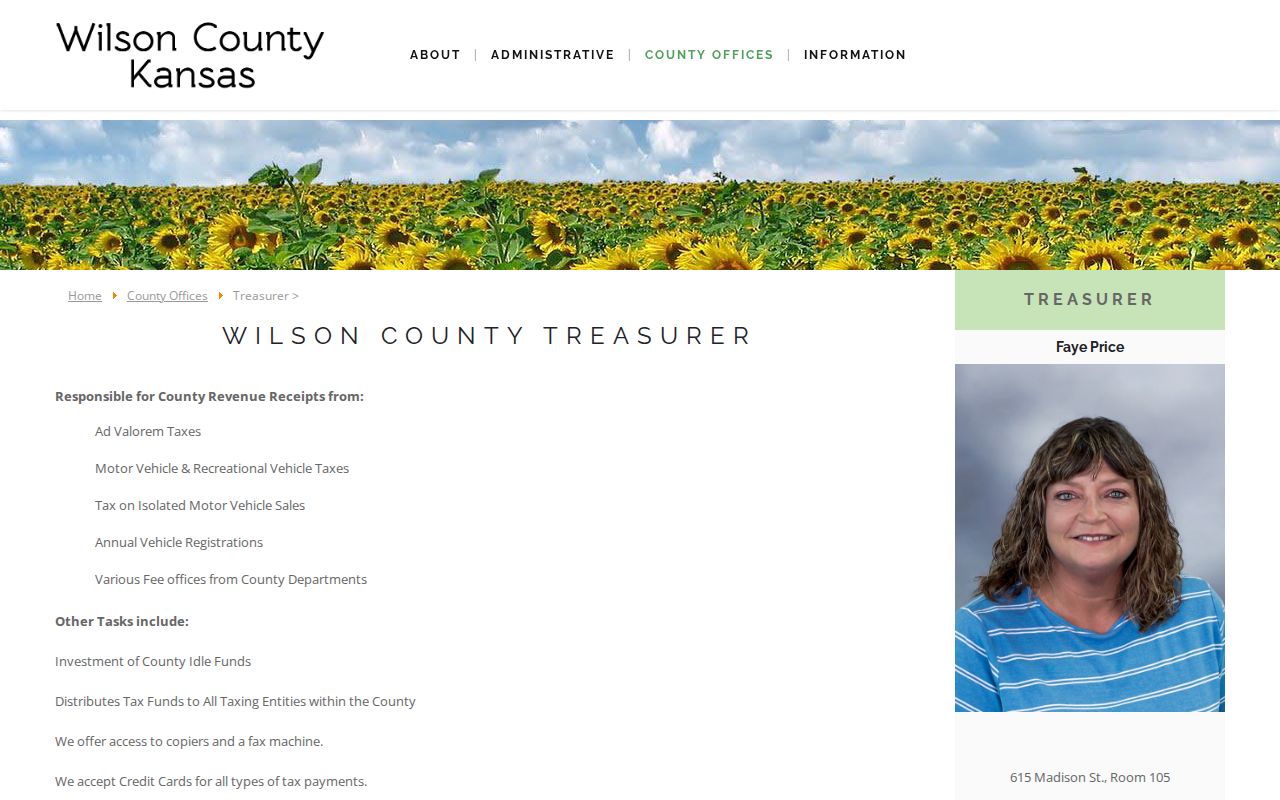
The Treasurer's official payment page lists current office hours and every accepted payment channel, so recheck it before making a property tax payment in person.
Wilson Refund Programs Are Separate
Kansas homestead and Safe Senior refunds flow through the state, not through the deed records. The 2025 KDOR material lays out K-40H, K-40PT, and K-40SVR routes. Each has its own age, income, ownership, and occupancy tests. Thresholds shift from one filing year to the next. A refund never changes the owner of record on a Wilson County parcel.
Check the Kansas Department of Revenue homestead FAQ. Pull the current form year before filing. The 2025 booklet capped the K-40H refund at $700 with income and home-value ceilings. Later filings follow later instructions. The Wilson County Clerk posts homestead links too.
Wilson Value Notices Name Owners
Valuation notices go to the owner named in the Register of Deeds records. That owner comes from the Wilson County Appraiser. The tax search itself is more flexible. It lets you match the Current Owner, the Taxpayer, or Both. That choice matters right after a transfer. It also matters when escrow handles the tax bill. It can matter when someone other than the owner of record pays the statement.
No county source publishes a fixed lag between a closing and the tax roll update. After a recent sale, set the latest recorded deed beside the tax display. Then ask the Appraiser when its roll will show the new deed. Note the date on each record rather than trusting the newest-looking screen.
Wilson Tax Sales Are Dated
Wilson County's official tax-sale page shows no upcoming sale. June 17, 2025 is listed as the most recent prior event. A 2025 presentation from the county includes parcel samples. It also shows CAMA and Quick Ref values, owners of record, appraised values, and legal descriptions. Treat it as a schema specimen. It is not a live sale list.
The presentation notes that the legal description controls, while maps and photographs are informational only. Before acting, check the current Wilson County tax-sale page. Remember that a delinquent statement, a lien, a published list, and a completed sale are distinct. Each one is a separate stage.
Dated due diligence. Never infer a pending sale from the 2025 presentation; verify current status and the controlling legal description.
Appeal Wilson County Assessments
Kansas requires valuation notices by March 1. An equalization appeal must follow within 30 days of mailing. Wilson County asks property owners to call or write inside that 30-day window. The statewide calendar sets an informal meeting by May 15. An appraiser determination follows by May 20. A 30-day BOTA appeal window then opens.
Payment under protest through the Treasurer offers another route. County material warns that both appeal methods cannot apply to the same tax year. Strong proof includes a recent sale, comparable sales, a fee appraisal, photos, and damage evidence. Rely on the current Kansas property-tax calendar for the applicable year.
Appeal window. Contact the Wilson County Appraiser within 30 days of the mailed real-property value notice, and preserve proof of the mailing date.